A quirk of Active Directory is that Organizational Units use an OU property rather than a CN property to define their place in the directory structure. In createobject messages you need to use CN= to create most objects. However, to allow you to create OUs we had to allow you to specify this with OU=MyNewOU.


What is ActiveADAPTER?
ActiveADAPTER is a set of BizTalk adapters for working with Active Directory from BizTalk Server. We offer you:
- A BizTalk Send Adapter that you can use to:
- Create, move and delete Active Directory objects
- Change object properties such as email addresses, office locations, home folder locations...
- Set user passwords and add objects to security groups
- A BizTalk Receive Adapter that you can use to query Active Directory and receive the results in an XML message into BizTalk Server
- The input and output schemas for all ActiveADAPTER operations
- Sample orchestrations and example XML input
- Complete documentation
Do you supply the schemas I will need?
Absolutely. A link to them is installed to the Programs menu in the ActiveADAPTER\Schemas folder.
What will ActiveADAPTER add to what I see in BizTalk Server?
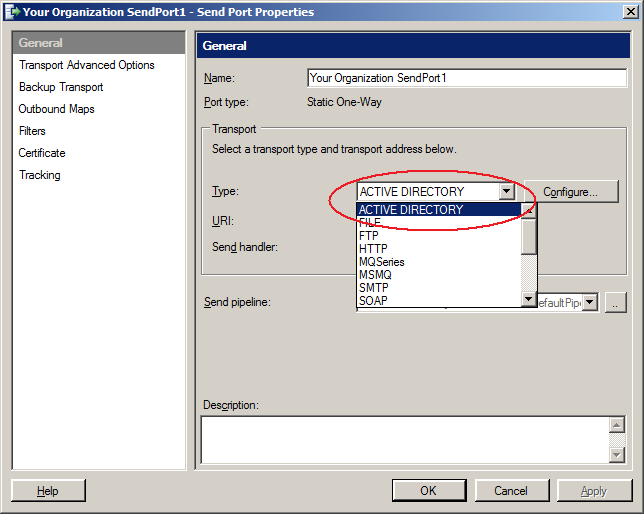
After installing ActiveADAPTER you will see a new transport type option when configuring a send port or receive location. With BizTalk send ports, you can create, delete, rename, move, and modify Active Directory objects. With BizTalk receive locations, you can draw XML messages into BizTalk containing Active Directory query results.
On your Programs menu you will also have an ActiveADAPTER program group containing shortcuts to documentation, sample orchestrations and schemas to get you developing your solutions quickly.